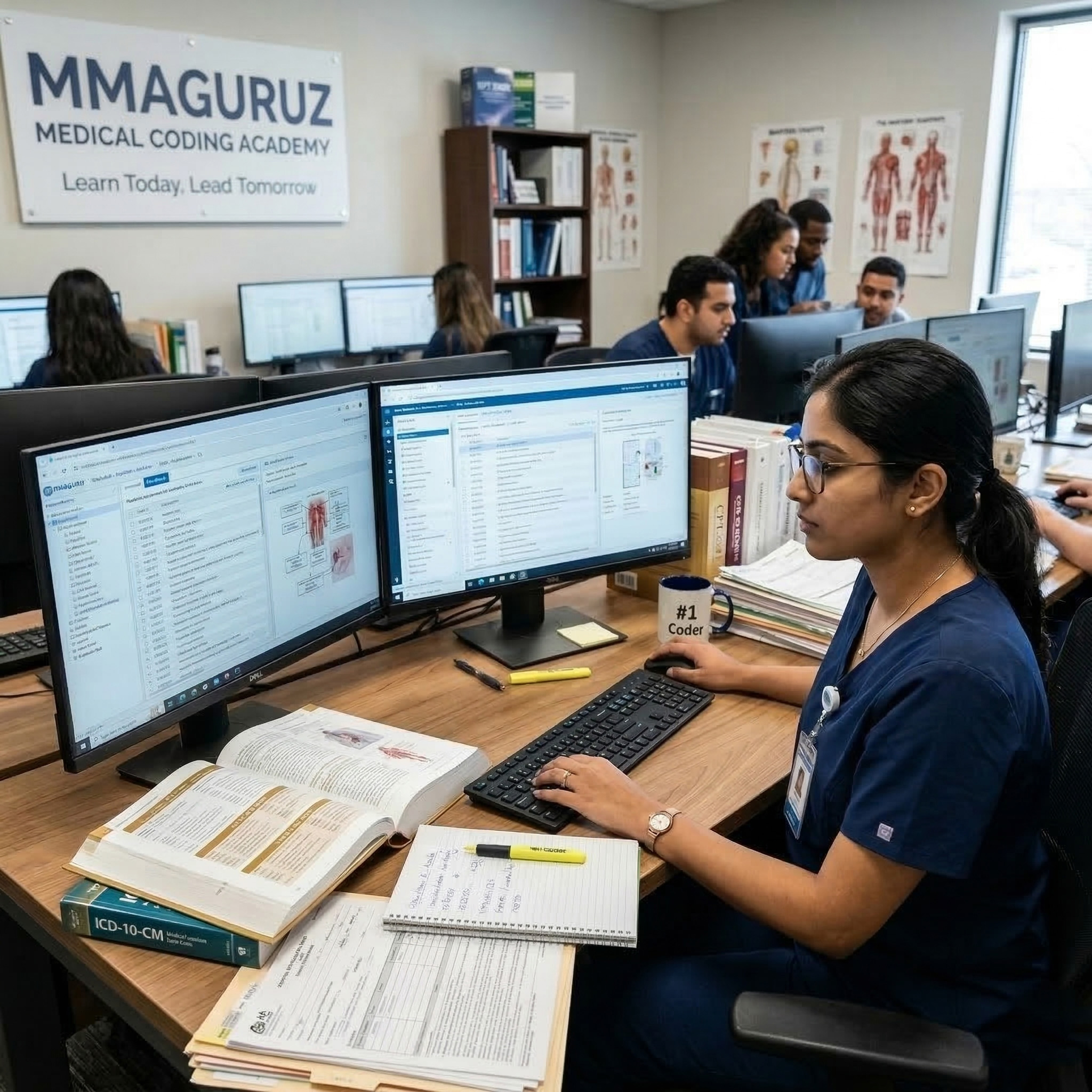
If you have ever wondered what is medical coding and why it has become one of the most in-demand healthcare careers in India — you are in the right place. In fact, thousands of pharmacy, nursing, and life science graduates across India are discovering medical coding as a highly rewarding, stable, and growing career path every year. Moreover, this career requires no programming skills and no engineering background — making it accessible to any healthcare graduate.
In simple terms, medical coding is the process of converting healthcare diagnoses, procedures, services, and equipment into standardised alphanumeric codes. These codes are then used by hospitals, insurance companies, and healthcare organisations for billing, claims processing, and medical record keeping. Therefore, medical coders play an absolutely critical role in the healthcare revenue cycle. In fact, without trained coders, the entire billing and insurance system would break down completely.
Consequently, in this complete guide, MMAGURUZ explains everything you need to know about medical coding — from the basic definition to coding systems, career scope, salary in India, and how to get started. Furthermore, if you are looking for a medical coding course in Pune, we will show you exactly how MMAGURUZ can help you get there.
Medical coding is the translation of healthcare diagnoses, procedures, medical services, and equipment into universal alphanumeric codes using systems like ICD-10-CM, CPT, and HCPCS Level II. These codes are used for insurance billing, claims processing, and maintaining medical records across hospitals, clinics, and healthcare organisations worldwide.
What is Medical Coding — Detailed Definition
The Role of Clinical Documentation
Every time a patient visits a doctor, undergoes a test, receives a medication, or gets a surgery, the healthcare provider needs to communicate what happened — accurately and in a format that insurance companies, government agencies, and hospitals can process. This is exactly where medical coding becomes essential. In other words, medical coding bridges the gap between clinical care and administrative processing.
What a Medical Coder Actually Does
A medical coder carefully reads through the clinical documentation — which includes the doctor’s notes, lab reports, imaging results, and discharge summaries. Subsequently, the coder converts all the diagnoses, procedures, and services into specific standardised codes. The billing team then uses these codes to generate insurance claims, process hospital bills, and maintain accurate patient records.
A Simple Real-World Example
For example, if a patient is diagnosed with Type 2 diabetes and undergoes a blood glucose test, the medical coder assigns the correct ICD-10-CM code for the diagnosis and the correct CPT code for the procedure. As a result, the insurance company can process the claim accurately and reimburse the hospital. Therefore, without the medical coder, neither the hospital nor the patient would receive the correct reimbursement.
How Does Medical Coding Work?
Medical coding follows a clear, step-by-step process. Understanding this process helps you see exactly what a medical coder does on a day-to-day basis.
The 3 Main Medical Coding Systems Explained
There are three primary coding systems used in medical coding. Furthermore, every medical coder must have a thorough understanding of all three — and all three are tested in the CPC certification exam. Therefore, it is important to study each system carefully during your medical coding course.
ICD-10-CM codes are used to report diagnoses — the diseases, conditions, injuries, and symptoms that a patient has. This is the most widely used coding system in the world, maintained by the World Health Organisation (WHO) and adapted for use in India and the United States.
CPT codes are used to report medical procedures and services performed by healthcare providers. Maintained by the American Medical Association (AMA), CPT codes cover everything from office visits and surgeries to radiology, pathology, and anaesthesia services.
HCPCS Level II codes are used to report medical supplies, equipment, drugs, and services that are not covered by CPT codes. This includes ambulance services, durable medical equipment (DME), prosthetics, orthotics, and specific medications.
What Does a Medical Coder Do Every Day?
Many students ask: What does a medical coder actually do at work? In fact, the day-to-day work of a medical coder is varied, intellectually engaging, and highly important to the healthcare system. Moreover, no two days are exactly the same — because every patient case is different.
Core Responsibilities of a Medical Coder
Read doctor’s notes, lab reports, operative reports, and discharge summaries to understand the patient’s condition and treatment.
Select the most accurate ICD-10-CM, CPT, and HCPCS codes for every diagnosis and procedure documented in the record.
Verify that all codes comply with HIPAA regulations, payer-specific guidelines, and AAPC coding conventions to prevent claim denials.
When documentation is unclear or incomplete, medical coders raise queries to the treating physician to clarify diagnoses or procedures before assigning codes.
Forward the coded claims to the medical billing team for submission to insurance companies for reimbursement processing.
Medical coding guidelines are updated annually. Coders must stay current with the latest ICD-10-CM, CPT, and HCPCS updates through continuing education.
Who Can Become a Medical Coder in India?
One of the most attractive aspects of medical coding is that it is accessible to a wide range of healthcare graduates. You do not need to be a doctor — in fact, the majority of successful medical coders in India come from pharmacy, nursing, and life science backgrounds. Furthermore, you do not need any programming or IT skills. As a result, the entry barrier into this career is significantly lower than most other healthcare professions.
B.Sc / M.Sc Life Sciences or BioScience
B.Pharm / M.Pharm / D.Pharm
B.Sc Nursing / GNM / ANM
MBBS / BDS / BAMS / BHMS
BPT / MPT / Allied Health Sciences
Working Professionals Seeking Career Change
What is CPC Certification and Why Does It Matter?
Why CPC Certification is Essential
The CPC (Certified Professional Coder) certification is the most recognised and respected credential in medical coding. It is issued by AAPC — the American Academy of Professional Coders — and is globally recognised as proof of coding expertise. In other words, the CPC credential tells employers that you have been formally tested and verified as a competent medical coder.
In India, 90%+ of top employers — Cognizant, TCS, Accenture, IKS Health, Optum, and Episource — either prefer or require CPC-certified candidates for medical coding positions. As a result, CPC certification significantly increases your starting salary and improves your placement chances. Moreover, it gives you a major competitive advantage over non-certified candidates in the job market.
MMAGURUZ’s dedicated CPC exam training programme achieves a 96% first-attempt pass rate — one of the highest in India — through 20+ full-length timed mock tests and expert mentorship.
Medical Coding Salary in India — What Can You Earn?
Medical coding offers one of the best salary-to-training-investment ratios of any healthcare career in India. Moreover, CPC-certified coders consistently earn 40 to 60 percent more than non-certified coders. As a result, the certification investment is highly worthwhile. In fact, most students recover their entire course fee within the first one to two months of their first medical coding job.
Salary Comparison — With and Without CPC Certification
| Experience Level | Without CPC | With CPC Certification |
|---|---|---|
| Fresher | Rs. 2–2.5 LPA | Rs. 3.5–6 LPA |
| 2–3 Years | Rs. 3–4 LPA | Rs. 6–9 LPA |
| 4–6 Years | Rs. 5–6 LPA | Rs. 9–14 LPA |
| 7+ Years Senior | Rs. 6–8 LPA | Rs. 15+ LPA |
How to Start a Medical Coding Career in India — Step by Step
Now that you understand what medical coding is and the career opportunities it offers, let us look at exactly how to get started in India. In particular, if you are based in Pune or anywhere in Maharashtra, MMAGURUZ has been training students since 2013 with exceptional results. Furthermore, online batches are available for students from any city across India.
Frequently Asked Questions — What is Medical Coding?
Here are the most commonly asked questions by students who are new to medical coding. These answers are based on MMAGURUZ’s 12+ years of experience training over 7,000 medical coders across India.
Ready to Start Your Medical Coding Career?
Join MMAGURUZ’s 3-month medical coding course in Pune — online or offline. Get CPC training, 20+ mock tests, and 100% placement support at top MNCs.
Shivajinagar, Pune | +91 99356 93159 | Online Batches Pan India | 96% CPC Pass Rate
Also Read
Disclaimer: Salary figures are based on industry data and MMAGURUZ placement records as of April 2026. Individual results may vary based on certification, performance, and market conditions.